What does it mean to dream about spiders?
Spiders provoke a reaction out of all proportion to their size, and dreams exploit it. A spider the size of a dog in the corner of the bedroom, a web across the doorway, legs on your skin, a nest bursting open: few dream images are so quick to wake people up. Yet the spider is also an age-old symbol of patience and skill, the weaver who builds a world out of its own body. Spider dreams move between those two poles, the creeping dread and the admired craft, and the details show which one your dream is about.
General meaning
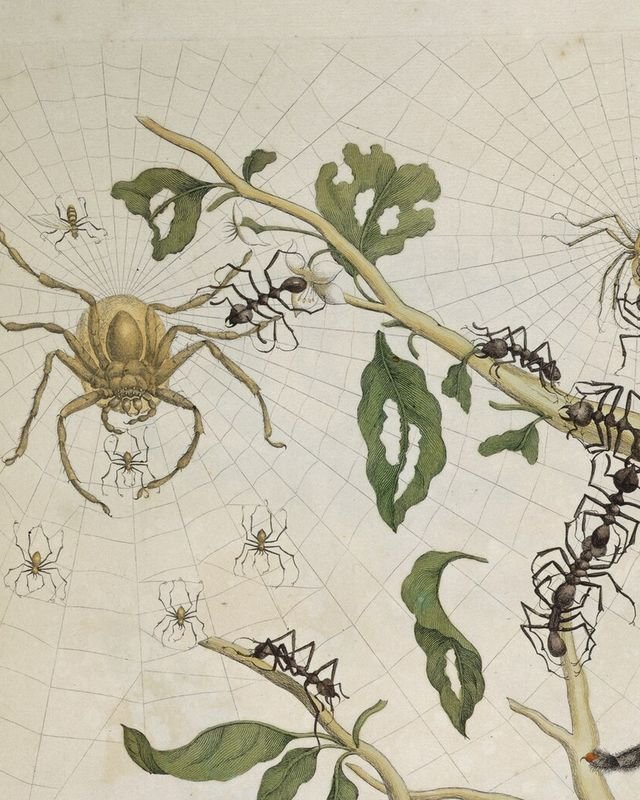
The spider in a dream usually comes with its web, and the web is often the key. A web is a structure built slowly, thread by thread, that catches whatever wanders into it. In a dream it can stand for something you are building — a project, a network, a plan — or for something you feel caught in: a relationship, a job, a debt, an obligation that tightens the more you struggle.
The spider itself tends to stand for whoever or whatever controls the web. Sometimes that is a person you experience as manipulative, possessive or quietly controlling. Sometimes it is a situation that has you trapped. And sometimes it is you, in your capacity to create, to wait, to plan in detail. Your feelings in the dream decide which: disgust and fear point to entrapment or intrusion, fascination points to creativity or patience.
Size and number matter too. A single small spider is often a minor worry magnified by the dream; a giant one, a problem that feels out of proportion; many spiders, a situation that has spread beyond your control. Where the spider appears — in your bed, your food, your hair, your home — tells you which part of your life feels invaded.
Through your tradition
Psychological interpretation (Jung, Freud)
The strength of the reaction spiders provoke has been studied closely. Fear of spiders is among the most common specific fears, and in a study published in Frontiers in Psychology, six-month-old infants showed larger pupil dilation, a sign of arousal, when looking at pictures of spiders and snakes than at pictures of flowers or fish (Hoehl and colleagues, 2017). The authors saw this as support for an evolved preparedness to develop these fears. Other research has found that spider fear is bound up with disgust as much as with danger: people who fear spiders tend also to find them disgusting, and disgust sensitivity predicts the fear. That combination may help explain the particular quality of spider dreams, which often involve spiders touching the skin, getting into food or emerging from inside something.
Psychoanalysis gave the spider a family reading. In a paper of 1922, the psychoanalyst Karl Abraham, taking up a remark of Freud's, read the spider in a patient's dreams as the wicked mother: dominating, feared and imagined as partly male. Few would apply that reading automatically today, but it remains useful when a spider dream seems connected with a person who feels possessive or smothering.
Jung, by contrast, noted in Psychology and Alchemy that the centre of the psyche, which he called the self, is often pictured as a spider in its web, especially while a person still fears the unconscious. On that reading, even a frightening spider sitting at the heart of a symmetrical web may point towards an inner centre that is taking shape.
Meaning in Islam
The Qur'an has a chapter named after the spider, al-'Ankabut, and its central image is the spider's house: "The example of those who take allies other than Allah is like that of the spider who takes a home. And indeed, the weakest of homes is the home of the spider, if they only knew" (29:41). The web looks like shelter and cannot protect; the verse uses it to describe any security that rests on the wrong support.
The tradition also remembers a web that protected. A widely told account of the Prophet's emigration from Mecca relates that, while he and Abu Bakr hid in the cave of Thawr, a spider spun a web across the entrance, so that their pursuers assumed no one had entered. Hadith scholars are divided over it: Ibn Kathir and Ibn Hajar judged the version in Ahmad's Musnad fair (hasan), while Ahmad Shakir found its chain doubtful; either way, the story remains beloved. In the dream manuals, the spider is read as a weak, scheming man or as a cursed woman who deserts her husband's bed; al-Nabulsi adds a weaver, a devout ascetic and a sorceress, and, citing 29:41, reads the web as weakness and frailty. Both sides — the fragile house and the protective web — can be present in a single dream.
In Christianity
The Bible uses the spider's web as an image of false security. In the Book of Job, the hope of the godless is compared to something whose "trust shall be a spider's web": he leans on his house, and it does not stand (Job 8:14-15). The web is fine, intricate and worthless as a support.
Christian legend adds a protective spider. According to the poems of Paulinus of Nola on Saint Felix, a priest persecuted in the third century, he escaped his pursuers by hiding in a ruined building; a spider spun a web over the opening, and the soldiers passed by, convinced no one could have gone through it. Similar stories are told in several traditions, and they give the spider a gentler role: a small, patient creature through which help arrives. A spider dream, read with both images in mind, asks whether you are relying on something that cannot hold, or being protected by something you had overlooked.
In Judaism
The Hebrew Bible's most intriguing spider may not be a spider at all. The King James Version renders Proverbs 30:28 as "The spider taketh hold with her hands, and is in kings' palaces", listing it among four small creatures that are exceedingly wise; many modern translations read the Hebrew word as "lizard" instead. The verse's point survives either way: something small and easily overlooked finds its way into the palace.
Later Jewish legend tells of King David, who once questioned why God had made the spider, a creature that weaves all year yet never wears what it weaves. When David fled from Saul and hid in a cave, God sent a spider to spin its web across the entrance, and Saul, seeing it unbroken, passed by. David learned that nothing in creation is useless. The story, told in the medieval Alphabet of Ben Sira, turns the spider in a dream from a nuisance into a reminder that help can come from what we despise.
In Hinduism
The Upanishads use the spider to describe creation itself. "As the spider sends forth and draws in its thread", says the Mundaka Upanishad, so the world arises from the imperishable (1.1.7). The image is precise: the spider does not build its web out of external material but from its own body, and it can take the thread back. The universe, in this picture, is spun out of the ultimate reality and returns to it.
That is an unusually positive reading of the spider, and it changes how a spider dream can be understood. The web you see in the dream may be something you are producing from yourself: plans, stories, relationships, worries. And what you spin, you can also draw back in. A dream in which you feel caught in a web may be inviting you to notice that some of the threads are your own.
In Buddhism
The Dhammapada uses the spider for the opposite lesson. "Besotted by lust they fall into the stream," it says, "like a spider caught in the web she wove" (verse 347, trans. Sujato). The web here is the self-made trap of desire: we spin it, we live in it, and we mistake it for the world.
The image fits spider dreams that feel claustrophobic, in which webs cover everything and the dreamer cannot find a way out. The Buddhist question is not who built the trap, but which threads come from your own wanting and fearing. The verse continues by praising those who cut through the web and leave, free from longing. The dream may be pointing to one thread that could be cut.
Common variations of this dream
Dreaming of a giant spider
A spider far too large for its surroundings is a dream of disproportion: a problem, a person or a fear that has grown until it fills the room. Often the real situation is smaller than the dream suggests, and the size of the spider measures how much space it takes up in your mind. If the giant spider does nothing, simply watching, the dream may be about a presence you feel but have not confronted. If it advances, the dream suggests the issue is coming to a head.
Dreaming of being bitten by a spider
The bite is the moment the threat makes contact. It tends to reflect a feeling of being harmed by someone subtle rather than openly aggressive: a remark that stung, a betrayal, a manipulation you noticed too late. The part of the body that is bitten can point to the area of life concerned. Notice whether the bite hurts or simply frightens you; many dream bites cause more fear than pain, which mirrors how some threats feel larger than they are.
Dreaming of spiderwebs
Webs without a spider are a dream about structures: things built slowly, whether by you or by others. A beautiful, dew-covered web can reflect admiration for patient work, your own or someone else's. Webs covering doors, furniture or faces point to neglect, stagnation or a situation that has been left untouched for too long. Walking into a web you did not see is a dream about getting caught in something unexpectedly: a commitment, a rumour, a tangle of obligations.
Dreaming of killing a spider
Killing a spider is usually a dream of regaining control: facing a fear, ending an entanglement, getting rid of an intrusion. The feeling afterwards matters. Relief suggests you are ready to deal with the problem; guilt or unease may point to a sense that you have destroyed something that was also useful, or overreacted. In some folk traditions killing a spider brings bad luck, which lends the dream a note of caution.
Dreaming of spiders crawling on you
Spiders on the skin, in the hair or in the bed are among the most distressing spider dreams, and they are strongly linked to disgust as well as fear. They tend to reflect a feeling of invasion: something getting too close, under your skin, into your private space. That can be a person, an obligation or a worry that will not leave you alone. If you calmly brush them off, the dream may be showing you that the intrusion is manageable.
Dreaming of many spiders
A room crawling with spiders, or a nest that bursts open, is a dream of a situation that has multiplied beyond control: many small problems at once, a social environment that feels hostile, or anxiety spreading into every area of life. Look for the source. If the spiders come from one place, the dream may be pointing to one cause behind many worries.

What does it mean in your dream?
Every dream is unique: context, emotions and details change everything. Tell Mimirra your dream and get a personalized interpretation in under a minute.
Interpret my dream →One free interpretation per day · No sign-up · 100% private
Frequently asked questions
Does dreaming of a spider mean money is coming?
The idea comes from a folk belief about real spiders, especially in Britain, where small "money spiders" are said to bring money if they run over you, and killing one is said to bring bad luck. There is no evidence that spider dreams predict income. The belief does show how old the spider's positive associations are, alongside its frightening ones.
Why are spider dreams so distressing?
Because spiders trigger two strong reactions at once: fear and disgust. Research suggests humans may be predisposed to develop a fear of spiders, and disgust makes the reaction more physical. Dreams often exaggerate both, with spiders on the skin or in food. The distress says more about how the brain reacts to spiders than about what the dream predicts.
What does a spider descending towards me mean?
A spider lowering itself on a thread is a classic image of something approaching slowly and deliberately: news, a person, a decision. In old British folklore, a little spider that dropped onto your clothes was a sign that money was on its way. In a dream, your reaction matters most: curiosity suggests openness to what is coming, while fear suggests you feel it is being lowered onto you without your consent.
Does a spider in a dream represent my mother?
Sometimes, in the psychoanalytic reading, when the spider feels possessive, entrapping or smothering. The psychoanalyst Karl Abraham linked spider dreams to a dangerous maternal figure. But that reading only fits some dreams, and the spider can equally represent a partner, a boss, a situation or your own capacity to plan and create. Dreams about your mother have their own page.
I am afraid of spiders. Do my spider dreams mean anything?
If you have a strong fear of spiders, spider dreams may simply reflect that fear, especially after an encounter with a real spider. They can still carry a message, since the mind tends to use its most powerful images for its most pressing concerns. If the fear affects your daily life, it is very treatable: exposure-based therapy is the best-supported treatment for specific phobias, and for spider phobia a single session of a few hours often brings lasting improvement.